Writing and reading fanfic is a masterclass in characterisation.
Consider: in order to successfully write two different “versions” of the same character – let alone ten, or fifty, or a hundred – you have to make an informed judgement about their core personality traits, distinguishing between the results of nature and nurture, and decide how best to replicate those conditions in a new narrative context. The character you produce has to be recognisably congruent with the canonical version, yet distinct enough to fit within a different – perhaps wildly so – story. And you physically can’t accomplish this if the character in question is poorly understood, or viewed as a stereotype, or one-dimensional. Yes, you can still produce the fic, but chances are, if your interest in or knowledge of the character(s) is that shallow, you’re not going to bother in the first place.
Because ficwriters care about nuance, and they especially care about continuity – not just literal continuity, in the sense of corroborating established facts, but the far more important (and yet more frequently neglected) emotional continuity. Too often in film and TV canons in particular, emotional continuity is mistakenly viewed as a synonym for static characterisation, and therefore held anathema: if the character(s) don’t change, then where’s the story? But emotional continuity isn’t anti-change; it’s pro-context. It means showing how the character gets from Point A to Point B as an actual journey, not just dumping them in a new location and yelling Because Reasons! while moving on to the next development. Emotional continuity requires a close reading, not just of the letter of the canon, but its spirit – the beats between the dialogue; the implications never overtly stated, but which must logically occur off-screen. As such, emotional continuity is often the first casualty of canonical forward momentum: when each new TV season demands the creation of a new challenge for the protagonists, regardless of where and how we left them last, then dealing with the consequences of what’s already happened is automatically put on the backburner.
Fanfic does not do this.
Fanfic embraces the gaps in the narrative, the gracenotes in characterisation that the original story glosses, forgets or simply doesn’t find time for. That’s not all it does, of course, but in the context of learning how to write characters, it’s vital, because it teaches ficwriters – and fic readers – the difference between rich and cardboard characters. A rich character is one whose original incarnation is detailed enough that, in order to put them in fanfic, the writer has to consider which elements of their personality are integral to their existence, which clash irreparably with the new setting, and which can be modified to fit, to say nothing of how this adapted version works with other similarly adapted characters. A cardboard character, by contrast, boasts so few original or distinct attributes that the ficwriter has to invent them almost out of whole cloth. Note, please, that attributes are not necessarily synonymous with details in this context: we might know a character’s favourite song and their number of siblings, but if this information gives us no actual insight into them as a person, then it’s only window-dressing. By the same token, we might know very few concrete facts about a character, but still have an incredibly well-developed sense of their personhood on the basis of their actions.
The fact that ficwriters en masse – or even the same ficwriter in different AUs – can produce multiple contradictory yet still fundamentally believable incarnations of the same person is a testament to their understanding of characterisation, emotional continuity and narrative.
So I was reading this rumination on fanfic and I was thinking about something @involuntaryorange once talked to me about, about fanfic being its own genre, and something about this way of thinking really rocked my world? Because for a long time I have thought like a lawyer, and I have defined fanfiction as “fiction using characters that originated elsewhere,” or something like that. And now I feel like…fanfiction has nothing to do with using other people’s characters, it’s just a character-driven *genre* that is so character-driven that it can be more effective to use other people’s characters because then we can really get the impact of the storyteller’s message but I feel like it could also be not using other people’s characters, just a more character-driven story. Like, I feel like my original stuff–the novellas I have up on AO3, the draft I just finished–are probably really fanfiction, even though they’re original, because they’re hitting fanfic beats. And my frustration with getting original stuff published has been, all along, that I’m calling it a genre it really isn’t.
And this is why many people who discover fic stop reading other stuff. Once you find the genre you prefer, you tend to read a lot in that genre. Some people love mysteries, some people love high-fantasy. Saying you love “fic” really means you love this character-driven genre.
So when I hear people be dismissive of fic I used to think, Are they just not reading the good fic? Maybe I need to put the good fic in front of them? But I think it turns out that fanfiction is a genre that is so entirely character-focused that it actually feels weird and different, because most of our fiction is not that character-focused.
It turns out, when I think about it, I am simply a character-based consumer of pop culture. I will read and watch almost anything but the stuff that’s going to stick with me is because I fall for a particular character. This is why once a show falters and disagrees with my view of the character, I can’t just, like, push past it, because the show *was* the character for me.
Right now my big thing is the Juno Steel stories, and I know that they’re doing all this genre stuff and they have mysteries and there’s sci-fi and meanwhile I’m just like, “Okay, whatever, I don’t care about that, JUNO STEEL IS THE BEST AND I WANT TO JUST ROLL AROUND IN HIS SARCASTIC, HILARIOUS, EMOTIONALLY PINING HEAD.” That is the fanfiction-genre fan in me coming out. Someone looking for sci-fi might not care about that, but I’m the type of consumer (and I think most fic-people are) who will spend a week focusing on what one throwaway line might reveal about a character’s state of mind. That’s why so many fics *focus* on those one throwaway lines. That’s what we’re thinking about.
And this is what makes coffee shop AUs so amazing. Like, you take some characters and you stick them in a coffee shop. That’s it. And yet I love every single one of them. Because the focus is entirely on the characters. There is no plot. The plot is they get coffee every day and fall in love. That’s the entire plot. And that’s the perfect fanfic plot. Fanfic plots are almost always like that. Almost always references to other things that clue you in to where the story is going. Think of “friends to lovers” or “enemies to lovers” or “fake relationship,” and you’re like, “Yes. I love those. Give me those,” and you know it’s going to be the same plot, but that’s okay, you’re not reading for the plot. It’s like that Tumblr post that goes around that’s like, “Me starting a fake relationship fic: Ooooh, do you think they’ll fall in love for real????” But you’re not reading for the suspense. Fic frees you up from having to spend effort thinking about the plot. Fic gives your brain space to focus entirely on the characters. And, especially in an age of plot-twist-heavy pop culture, that almost feels like a luxury. “Come in. Spend a little time in this character’s head. SPEND HOURS OF YOUR LIFE READING SO MANY STORIES ABOUT THIS CHARACTER’S HEAD. Until you know them like a friend. Until you know them so well that you miss them when you’re not hanging out with them.”
When that is your story, when the characters become like your friends, it makes sense that you’re freed from plot. It’s like how many people don’t really have a “plot” to hanging out with their friends. There’s this huge obsession with plot, but lives don’t have plots. Lives just happen. We try to shape them into plots later, but that’s just this organizational fiction we’re imposing. Plot doesn’t have to be the raison d’etre of all story-telling, and fic reminds us of that.
Idk, this was a lot of random rambling but I’ve been thinking about it a lot lately.
“fanfiction has nothing to do with using other people’s characters, it’s just a character-driven *genre* that is so character-driven that it can be more effective to use other people’s characters”
yes!!!! I feel like I knew this on some level but I’ve never explicitly thought about it that way. this feels right, yep. Mainstream fiction often seems very dry to me and I think this is why – it tends to skip right over stuff that would be a huge plot arc in a fanfic, if not an entire fanfic in itself. And I’m like, “hey, wait, go back to that. Why are you skipping that? Where’s the story?” But now I think maybe people who don’t like fanfiction are going like, “why is there an entire fanfic about something that could have happened offscreen? Is anything interesting ever going to happen here? Where’s the story?”
Yes! Exactly! This!!!
This crystallized for me when I taught my first class of fanfiction to non-fic-readers and they just kept being like, “But nothing happens. What’s the plot?” and I was so confused, like, “What are you talking about? They fall in love. That’s the plot.” But we were, I think, talking past each other. They kept waiting for some big moment to happen, but for me the point was that the little moments were the big moments.
This is such an awesome conversation, but I think there’s
even another layer here that makes ‘fic’ its own genre. And it is the plot.
Everyone who’s experienced in reading fic has their little ‘trope
plots’ we are willing to read or even prefer in order to spend time with our
favorite characters. We know how it’s gonna end and we genuinely don’t care,
because the character is the whole point of why we’re reading. And that is
unique. That’s just not how mainstream media publication does things.
But there are also hundreds of thousands of fics people
might call ‘plot driven’ and they have wonderful, intricate plots that thrill
their readers.
But they’re not at all ‘plot driven’ in the same way as
other mainstream genres.
The thing about ‘plot’ in fic is that it tends to ebb and
flow naturally. There’s not the same high speed, race to the finish you’d get
from a good action movie. There’s no stop and start of side plots you get in TV
genre shows. The best fic plot slides from big event to restful evening to
frantic activity to shared meals and squabbles and back, and it gives equal time and attention and detail to each of these
things.
Like @earlgreytea68 said, “There’s this huge obsession with
plot, but lives don’t have plots. Lives just happen. We try to shape them into
plots later, but that’s just this organizational fiction we’re imposing. Plot
doesn’t have to be the raison d’etre of all story-telling, and fic reminds us
of that.”
Fic plot moves at a pace similar to the life of whatever
character it’s about. Not the other way around. There’s a fundamental difference in prioritization in fic.
I think this only adds to the case of ‘fic’ as its own,
distinctive genre. Stylistic choices of writing that would never work in
traditional, mainstream fiction novels work for novel-length fic. Fic
adventures spend as much time fleshing out the little moments between romances
and friendships as they do on that plot twist. The sleepy campground
conversations are as important to the plot as the kidnapped princess, because that’s
how the characters are going to grow together by the end of the story. It’s not
a grace note, it’s not a side episode or an addition or a mention – it’s
integral and equal.
That’s just accepted as fact by fic writers and readers. It’s
expected without any particular mention. And it gives a very unique flavor and
pace to fic that makes a lot of mainstream stories feel like stale, off-brand
wonderbread. They are missing something regular fic readers take for granted
(and it isn’t just the representational differences, because we all know that’s
a whole different conversation). There’s a fundamental difference in how ‘fic’
is written, detailed, and paced that is built on its foundations as a ‘character
driven’ genre.
And it isn’t only action/adventure/mystery plots that have
this difference in fic. Those ‘everybody’s human in today’s world’ AUs, those ‘friends
to lovers’ slow burn stories have it too. They have a plot, but it’s the life –
the grocery shopping, the dumb fights and sudden inescapable emotional blows, those
moments of joy with that person you click with, managing work and family and
seasons – that’s the whole plot on its own.
And that’s almost impossible to explain to someone who hasn’t
really experienced fic as a genre, who’s used to traditional person A and person
B work together/overcome differences/bond to accomplish X. In fic accomplishing
X might be the beginning or the middle, not the end result of the story, and A
& B continue to exist separate from X entirely. X is only relevant because
of how it relates to A & B, not the other way around.
Fic is absolutely its own genre and it has a lot to do with plot. I’ve been calling this ‘organic
plot’ in my head for months, because I knew something felt different about
writing this way, how long fic plot ebbs and grows seemingly on its own
sometimes. ‘Dual plot’ could be another option, maybe, though the character plot and
life experience plots aren’t really separate. Inverted plot? Hm. I’m sure a good term will develop
over time.
This last addition.
I’m reminded of this post, which got unexpectedly popular and so must have resonated with a lot of people. The contrast between the reader who will happily read 100k words of nothing but character dynamics and dialogue, and the author who is dying inside every time a chapter passes by without an explosion because they feel their work is too boring to put to page, is probably a result of the author internalizing mainstream storytelling expectations about what makes “good”/ “exciting” writing.
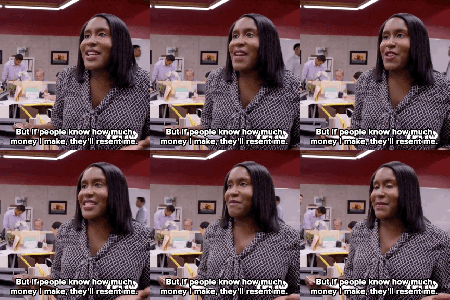
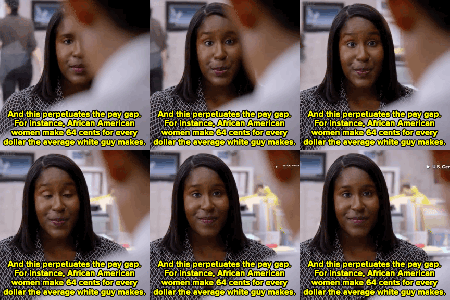
At my last company, one day someone in accounting approached me at lunch and quietly told me I need to ask for a raise because I was way underpaid.
They gave me a number to shoot for. It was about twice than what I had been making at the time.
So I went online, did some research, found some figures backing up my claim, put it all together and went to my boss.
I got what I asked for.
If it hadn’t been for that person in accounting telling me I was way underpaid, I’d have never known. I went from barely scraping by to being able to have a savings account and getting all my debts paid thanks to them.
You should at least check sites like salary.com to start the process of seeing what you should be making.
Because this is crucially important
Except for the fact that 90% of the time you are under contract not to talk about your salary otherwise the company can sue you. Every job I’ve had I’ve had to sign that I won’t discuss my pay with other employees otherwise my employment is terminated and the company will take legal action.
Honestly if you’re female and you’re called for jury duty and during the elimination process you’re asked if you’ve ever had any adverse experience with a man (harrassment or rape or any other male violence) just fuckin lie and say no. Then vote that fucker guilty
Women survivors are barred from serving on a jury but rapists are not even questioned. There can be no doubt that this is a major reason rapists walk free. Men have never played fair. It is time for women to start beating them at their own game. Our lives depend on it.
i dont get offended at white people jokes even though im white because:
i can recognize white people as a whole have systemically oppressed POC in america, which is where i live
most people when they make white people jokes only mean the shitty white people and i am not a shitty white person
im not a pissbaby
my white friends that have reblogged this give me life
4. Sometimes I am a shitty white person and the jokes remind me to FUCKIN STOP
If ur white and like this post I fux with u
^absolutely
5. It’s hard to be offended when white people jokes involve bland food/tourist dads in socks and sandals/white girls in yoga pants obsessed with pumpkin spice/suburban PTA moms and other harmless and mostly true stereotypes while jokes about POC involve them being called thugs/criminals/slurs/uneducated/illegal immigrants.
i fucks with u heavy if ur white and you reblog this
6. They’re usually really fucking funny and don’t perpetuate stereotypes that will ever affect me economically, politically, or cause me any true harm, let alone create risks that “justify” my murder and/or death
Waits for my white mutuals to reblog😌
yesyesyesyes
(When I go to restaurants and they ask how spicy you want things, I say “white girl spicy” because I can’t handle the heat. It always gets me a laugh. It also gets me what I need (super mild.) Everyone wins.)
I had no idea giant porcupines made fucking precious sounds
THAT’S THE SOUND IT MAKES!?!?!?
UN-BE-FUCKING-LIEVABLE
We got asked if this is cute and okay. I can very happily say yes, this is stupid cute and those are happy porcupine noises.
One of my favorite things about doing zoo work was all the noises you never realize the animals make when they’re excited or interested in a new thing. Coatimundis squeak and snuffle, and giant porcupines make that sound.
Omgggg the sounds.
Teddy is back on my dash and all is right with the world
I also love how it seems like pumpkins are like this almost universally safe thing to give just about any animal? Like are there any it’s actually bad for? I imagine that’s part of why it’s such a popular enrichment item, aside from being like the quintessential symbol of autumn.
so on the subject of stolen property, i’ve seen various arguments on this point but it is in fact true that inheriting something from a relative, when you know full well that it was stolen, does not make it yours.
this clearly goes doubly so for powerful magical artifacts, and especially for artifacts which are strongly implied to contain part of their creator’s soul!
you can talk about consequences – maybe the artifact in question has benefits for you, maybe you’re not convinced its rightful owners would use it responsibly – but talking about the consequences doesn’t erase the fact that whatever benefits you think you’re getting are achieved through wrongful means.
which is why i, too, think Frodo should have given the One Ring back to Sauron. thief.
Hahahahaha here comes the law student nerd ready to complicate your wonderful post, op.
(Really this is just pretext for me to study for my property final in a week, so thanks yeah)
Because according to the principles of common property law, the matter of who actually owns title to the One Ring becomes really complicated really fast.
Buckle up babes for the pedantic law lecture no one asked for.
The best part of this is: trust me I guarantee Tolkien knew this much about the Common Law (English mediaevalists end up knowing ridiculous amounts about both Common Law and mediaeval Catholicism whether we want to or not), and indeed if you look at the text, this was relevant to the story.
It’s part of the reason that Sauron is as terrified of Aragorn’s potential claim on the Ring as he is of Gandalf’s or Saruman’s or Galadriel’s – if not more. Because in Middle Earth this shit matters. This is a world where a broken oath will literally bind your unhappy restless soul to the earth in spite of the dictates of the literal creator of the universe (who designated humans as Passing Beyond The World when they die). This is a world where a damn oath is responsible for Everything That’s Wrong With The First And Second Ages.
Oaths, ownership, duties, rights, things owed and owing: this shit matters.
And sure Aragorn is also direct line from Lúthien, but so is Elrond, and so are Elrohir and Elladan. So is Arwen. But what none of them have that Aragorn has? Is a rightful claim to ownership of the Ring.
So much of what Aragorn spends his time in the second and third volumes doing is Establishing Claim – establishing that everything that Isildur owned, he now owns. Why? Because it means he has power that is absolutely needed. “Isildur’s Heir” isn’t a woo-woo floofy-high-concept thing: it’s a literal matter of rights, duties and authority.
When he takes the Palantír from Gandalf and uses it, his companions are aghast, but he reminds them that he has both the right and the strength to use it – and the Right is actually important. Saruman was, face to face, stronger than Aragorn (never doubt that) and Sauron completely pwned him, but Saruman had no right to the Seeing Stone, no more right than Pippin.
But the Palantíri belonged to Aragorn: he’s not only Melian’s ever-so-great-grandchild, he’s also Fingolfin’s ever-so-great-grandchild, and since the Fëonori died out with the poor Ringmaker, the only competition Aragorn could have for ownership of the Stones are Galadriel and Elrond. (And that’s only if you are going right back to the maker-rights, and ignoring the establishment of the Stones as the property of Elros’ line rather later).
It matters. It changes how power works and doesn’t work. Aragorn’s status as the Heir is in fact grounded in these ideas, which play a hugely powerful part (in fact the fight over who rightfully owns the Silmaril Beren and Lúthien brought out of the dark is part of the bloodshed that makes it so that in the end the Silmarils themselves actively reject the last two living sons of Fëanor, negating their claim). Because Aragorn is the rightful inheritor of everything Isildur ever had, he can use the Palantír. Because he is the rightful inheritor of everything Isildur ever had, he can summon the Dead. And because he is the rightful inheritor of everything Isildur ever had, he stands equal to two of the Ainur, to the oldest member of the Trees-blessed Noldorin royal house, and to his own much more powerful (straight up) relatives as a potential claimant of the Ring.
And that is why Sauron is willing to take the chance to catch Aragorn, and (he thinks) ensure his capture, rather than attacking him earlier on when there’s a chance that (even if Aragorn can’t possibly WIN) he could still escape and then bide his time before the next Ring-War and learn to use the damn thing.
But. It’s also important when it comes to Frodo.
Frodo uses the Ring twice, and lays open claim once. Both of the times he uses it are on Sméagol, both times overwheming him and in the second case cursing him (“if you ever touch me again you will be thrown into the fire”). We get both moments from Sam’s POV, where the physical reality of Frodo is replaced by an image of him as a much larger figure, alight from the inside, robed in light, and with a “wheel of fire” at his breastbone.
Frodo does not have any genetics (so to speak) more special than any other hobbit. It’s not like Aragorn vs most humans, where there’s actually a legit difference because most humans were not, at that point, descended from a Maia. Frodo’s just this guy.
The only thing that’s really special about Frodo in terms of the Ring is that, like Aragorn, he’s the other person who has a viable claim. It would, as it were, have to go to the judges to figure out whose claim is better.
And this is why in the moment that he claims the Ring, in the Mountain, Sauron is fucking terrified. It’s why he drops everything else, even the issue of trying to keep his mindless drone-fighters going, even the maintenance of his actual control of weather, of light, of whatever fight he and Gandalf have going, to get his best servants back to the Mountain now now now now.
Because Frodo having an actual rightful claim on the Ring means he can, in fact, use it. Not well, which is why Sauron can paralyse him for that moment it takes for Sméagol to strike (and carry out both Frodo’s demanded oath – “save the Precious from Him” – and his Curse – “if you touch me you will be thrown in the fire” – at once), but he could. This tiny little person is a threat to Sauron, in the heart of his own home, because he has the right to have and use this Ring.
The tricky thing about Tolkien is that whatever his flaws (and he has many), the one thing he’s never unclear of is that the concept of right and might are actually separate. Just because you are strong enough to do or take a thing doesn’t mean you have any right to do it; and just because you aren’t strong enough to enforce your right, doesn’t mean it goes away.
…/UTTER NERD
I had a nerdgasm just reading this.
This is good and you should all feel good for writing it.
(As a former lawyer there is NOTHING better for studying than arguing fake cases in your favorite fictions. Things you thought you were tired of reading about suddenly become interesting when you are trying to prove some fucker wrong on the internet about like, whether or not testimony counts as hearsay if you can prove that the speaker was under the effects of a magical truth-enforcing curse.)



















 The Archery Range