
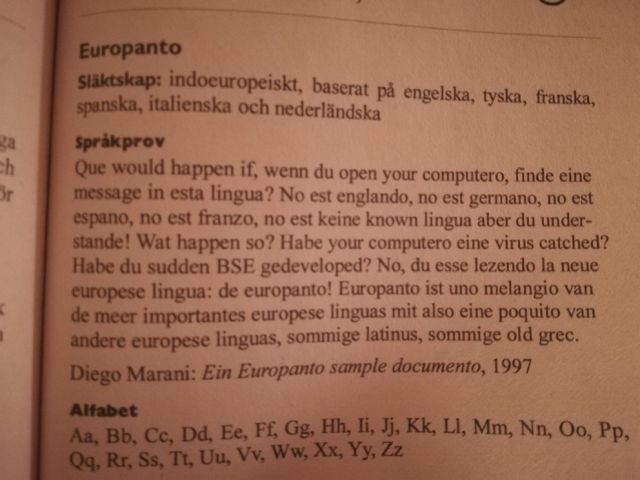
I don’t even know. It’s from a book about languages my friend’s been reading. (it’s creepy that I can understand it …)
It was actually invented with that purpose: anyone who spoke any European language should be able to understand esperanto. It was meant to be a lingua franca.
STOP WHAT YOU’RE DOING Y’ALL AND TELL ME IF YOU UNDERSTAND THIS
I’ve gotten so used to reading science in other languages that this seemed perfectly fine to me, for far too long :<
I laughed at loud at BSE (since we are now 20 years out from 1997, BSE = “mad cow disease" – in 2017 tumblr people say “am I having a stroke” for the same purpose)
Europanto =/= Esperanto.
The point of Esperanto is to be as consistent as possible, but you can’t just pick it up and understand it with no training.
I speak English as a native language, have a fair amount of training in French, exposure in Spanish, loose familiarity with German and Yiddish, and the basics of Latin/Greek that they teach you when they’re explaining how words get put together in English. I’m a little bit of a linguistics nerd but not an expert by any means. Esperanto looks completely different to me–I would have to learn it to get it. Europanto is something where reading it would take a little while to acclimate to but all the samples I’m looking at right now are pretty easily understood.
Esperanto was invented in the late 1800s. Europanto more than a hundred years later.
Europanto has this sort of creole/pidgin feel to it, where it feels like what naturally evolves when you have a busy marketplace full of people from “everywhere”.
 The Archery Range